



NPS Quagga mussels are an invasive species infesting multiple lakes in the Southwest. They are native to seas in Eastern Europe and were first discovered in the United States in the Great Lakes Region in the 1980s. Quaggas multiple rapidly, are easy to spread, and cause harm to the environment, equipment, and infrastructure as they encrust and clog boat engines, shorelines, and anywhere else conducive to their growth. Thousands of adult quagga mussels have been found in Lake Powell, attached to canyon walls, the Glen Canyon Dam, boats, and other underwater structures. Adult mussel populations are expected to expand and increase as the season progresses and over the next few years. Your Boater ResponsibilitiesIt is illegal to transport invasive species regulated by federal or other jurisdictional laws into the U.S. and across state and international borders. It is crucial to keep the mussels from moving from Lake Powell to other lakes and rivers. Boaters can help by making sure your vessels and equipment are not contributing to the problem. Cooperate with prevention and containment efforts at Lake Powell and all your favorite waters to help stop the spread of aquatic invasive species like mussels. Launching at Lake Powell/Colorado RiverEnsure your watercraft and equipment arrive clean, drained, and free of aquatic hitchhikers. Remember to put your plugs back in before launching. Exiting Lake Powell/Colorado RiverAll Motorized Vessels:
Jet Boats and Personal Watercraft (PWCs)
Non-Motorized WatercraftCanoes, rafts, kayaks, rowboats, paddleboats, inflatables, sculls, and other non-motorized recreational watercraft also require proper treatment.
Clean. Drain. Dry.Follow the Clean. Drain. Dry. procedure for every body of water, every time.
State LawsUtah and Arizona state laws require you to CLEAN, DRAIN, and DRY your boat when leaving Lake Powell using self-decontamination procedures. Additional steps are required if you launch on other waters without a significant drying period or if you are on Lake Powell for more than 5 days. No matter where you are headed next, it is illegal to transport aquatic invasive species. Prevent Delays and Reduce Costs Associated with Transporting, Buying, and Selling Boats
Communication Prevents DelaysThe western state and provincial AIS coordinators know the laws and regulations for their jurisdictions, and they’re available to assist you by informing you of their laws and providing you with any other tools and information you need to successfully transport a boat, or sell/auction a boat, particularly those coming from water bodies infested with aquatic invasive species. Contact any western state or provincial AIS coordinator. Commercial Boat Haulers – Call Before You HaulHere’s what you can do to comply with state laws and help prevent the spread: Professional DecontaminationPrivate businesses offer decontamination services in Page, AZ and near Bullfrog, Utah. The following businesses have been certified through Watercraft Inspection and Decontamination Training set forth by the Pacific States Marine Fisheries Commission and US Fish and Wildlife Service through the 100th Meridian Initiative. They can provide vessel decontamination services for a fee. These are independent business and are not associated with the National Park Service. 
NPS It's Not Just for BoatersAnglers, kayakers, swimmers, even seaplane pilots need to Clean. Drain. Dry. their equipment. Those fishing in the Lees Ferry area will find wader cleaning stations at multiple locations, available to help clean, drain, dry boots and equipment on site. There are aquatic invasive species besides quagga mussels found at Lees Ferry. FAQ: Quagga Mussel Update for Lake Powell Last updated March 2023
The reproducing population of quagga mussels expanded to all areas of Lake Powell, including the Escalante and San Juan arms of the lake. Adult mussels can be obvious near the surface in all parts of the lake, but they are less numerous and harder to find near inflows. Even with the high population levels in the southern lake, which are becoming a nuisance, no major infrastructure failures have been noted. The population of mussels has been expected to continue to grow and become more dense in all areas, but in 2017, mussel spring reproduction in the southern portion of Lake Powell was lower than in 2016. As the lake level fluctuates, the NPS is monitoring for other ecosystem effects, not only from mussels, but also aquatic vegetation. These effects can include increased aquatic vegetation, algal blooms, and decreased sport fish. Visitors are encouraged to report anything unusual. So far, not many ecological effects from mussels have been seen, except several waterfowl species (coots and common goldeneye) seem to be eating mussels. Evidence also exists that some sportfish are eating mussels.
Quagga mussels were identified in sampling locations between Glen Canyon Dam and Lees Ferry in November 2014. Mussels continue to be found in the river below the dam. Their distribution is patchy and highly influenced by fluctuating water levels and location-specific flow regimes.
Adult mussels have also been found downstream in Grand Canyon. Mussel larvae (veligers) pass through the Glen Canyon Dam and seek to attach to substrates in the river. In 2007, the U.S. Geological Survey published an assessment on the risk of quagga mussels establishing in the Colorado River Ecosystem below Glen Canyon Dam. The report found that while establishment within Glen Canyon was likely, that the sediment levels in Grand Canyon might limit their ability to become established below the Paria River. The report also points out that negative ecological impacts in the river could be low and that moderate densities of quagga mussels may increase food available to fish, increase the complexity of habitat and stimulate additional benthic production. A link to the report can be found at http://pubs.usgs.gov/of/2007/1085/.
There are no current technologies or treatments that would allow for eradication in an open water environment the size of Lake Powell. When mussels were still isolated in the southern portion of the lake, options to slow the spread of mussels within Lake Powell, such as restrictions on boat movements, were considered. However, due to questionable efficacy, significant disruption to visitors and lake operations, and the difficulty of enforcing restrictions, these options were not implemented. Veligers are also dispersed upstream by wind-generated currents and were always expected to colonize the entire reservoir regardless of any boat movements. In 2016, mussel reproduction was detected in all areas of the lake.
The Aquatic Invasive Species (AIS) Program at Glen Canyon National Recreation Area has transitioned from a focus on prevention of mussels being introduced into the lake, to a focus on containing the spread of quagga mussels from Lake Powell to other bodies of water. Boaters are still contacted on the ramp, but a higher priority is placed on boats leaving to assure they have taken the necessary steps to protect other waters and comply with the law.
The NPS identified and ranked the relative risks of different pathways for both the introduction of aquatic invasive species to Lake Powell and the potential spread of quagga mussels from Lake Powell. For spread of adult mussels, long-term slipped and moored watercraft were identified as a high risk vector. Short-term come-and-go watercraft were identified as a lower risk for spreading adult mussels. The NPS has developed appropriate strategies to prevent mussels spread for each of these classes of boats. ALL VESSELS AND EQUIPMENT BEFORE LAUNCHING: Required self-decontamination (Clean, Drain, and Dry). If visible mussels or other invasive species are identified the vessel will be prevented from launching until the threat can be removed.
Glen Canyon offers decontamination services for any non-agency-controlled vessel (other than concessioner, contractor, permittee) observed entering or exiting the park with confirmed visible (or detectable) aquatic invasive species when no other options for control exist. Glen Canyon National Recreation Area does not have the infrastructure or the resources to decontaminate the hundreds of thousands of watercraft using Lake Powell. The NPS will work with local entities to increase inspection and decontamination capability to serve Lake Powell boaters. If self-decontamination will not work for a visiting boater, professional decontamination is available from private businesses near Lake Powell as well as state operated facilities in Utah. NPS employees as well as staff from the states of Utah and Arizona can provide information on professional decontamination services, when necessary.
The invasive species education program has been expanded to include additional information on the procedures required by both Utah and Arizona state laws concerning mussels and other invasive species.
As agencies and stewards of the resources at Glen Canyon National Recreation Area, we are actively working to create and implement Hazard Analysis Critical Control Point (HACCP) plans for all aquatic and terrestrial construction, resource work, and research permits, to prevent introductions of new species and containment with respect to the species already present in Lake Powell. HACCP plans are a risk management strategy which includes five (5) integrated steps (activity description, flow of activity, identifying potential non-targets [invasive species], analyzing risk of moving non-targets [invasive species], and completion of the action plan) aimed to reduce the risk of spreading invasive species and other non-targets [invasive species] via human-based pathways [human activities]. Where potential for introductions exist, HACCP plans highlight the opportunities for prevention and containment and provide specific control measures with safeguards to ensure those control measures are operating as intended. The NPS operated a very aggressive mussel prevention program at Lake Powell from 2000 to 2013. The approximate cost of the program was over $7.5 million dollars.
Impacts from an invasive species in a new environment cannot be predicted with precision; however, mussel impacts are well documented in the Great Lakes and Lake Mead provides a relatively similar system to Lake Powell that can be used to anticipate impacts. Glen Canyon works closely with Lake Mead NRA. Quagga mussel impacts in the Great Lakes includes
Even with quagga mussels already in Lake Powell, potential invasion by other aquatic invasive species are of concern. Zebra mussels (a close relative of quagga mussels) remain a threat to Lake Powell, as do a virtually unlimited number of other aquatic species that could be spread to the Lake. Any aquatic species that is transported to new waters can become a problem. All water resource users should Clean, Drain, and Dry their equipment after each use.
Preventing the spread of mussels is everyone's responsibility. Glen Canyon National Recreation Area participates in meetings with approximately twenty partner organizations representing local, state, and federal entities and businesses to coordinate mussel prevention and containment efforts at Lake Powell. The states of Utah and Arizona have established laws and regulations to prevent the spread of mussels, begun development of inspection and decontamination capability across the states, and mounted aggressive education campaigns. Other Department of Interior agencies, such as the Bureau of Reclamation, U.S. Geological Survey, and the U.S. Fish and Wildlife Service are very active with research to control mussels, educate boaters, and fund efforts to stop the spread.
When leaving Lake Powell, all watercraft and equipment are required by state laws to be decontaminated. Most boaters need only self-decontaminate: clean, drain, and dry their boats, watercraft, and equipment. No matter where you are headed next, it is illegal to transport aquatic invasive species. Clean, drain, and dry! The spread of mussels and other aquatic invasive species is preventable. Cooperate with prevention and containment program efforts at Lake Powell and other water bodies. Spread the message, not the mussels. 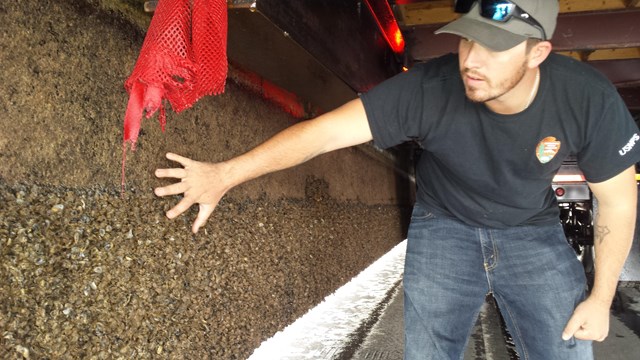
Quagga Mussel Containment Program
Glen Canyon's extended response strategy to minimize the spread of invasive mussels from Lake Powell and to manage park operations 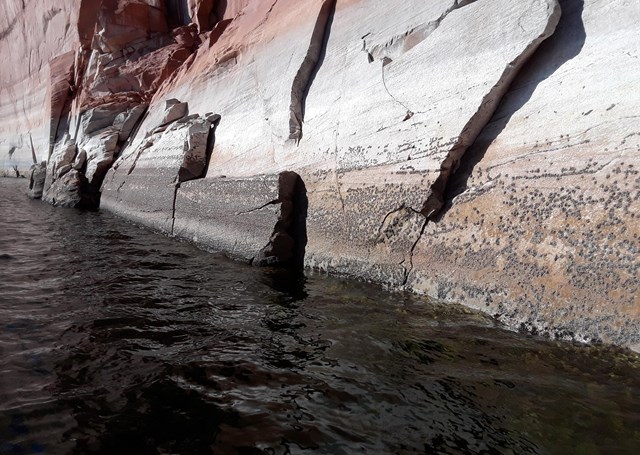
History of Mussels at Glen Canyon
Glen Canyon was at the forefront of the movement to detect and prevent the spread of aquatic invasive species since the threat became known. 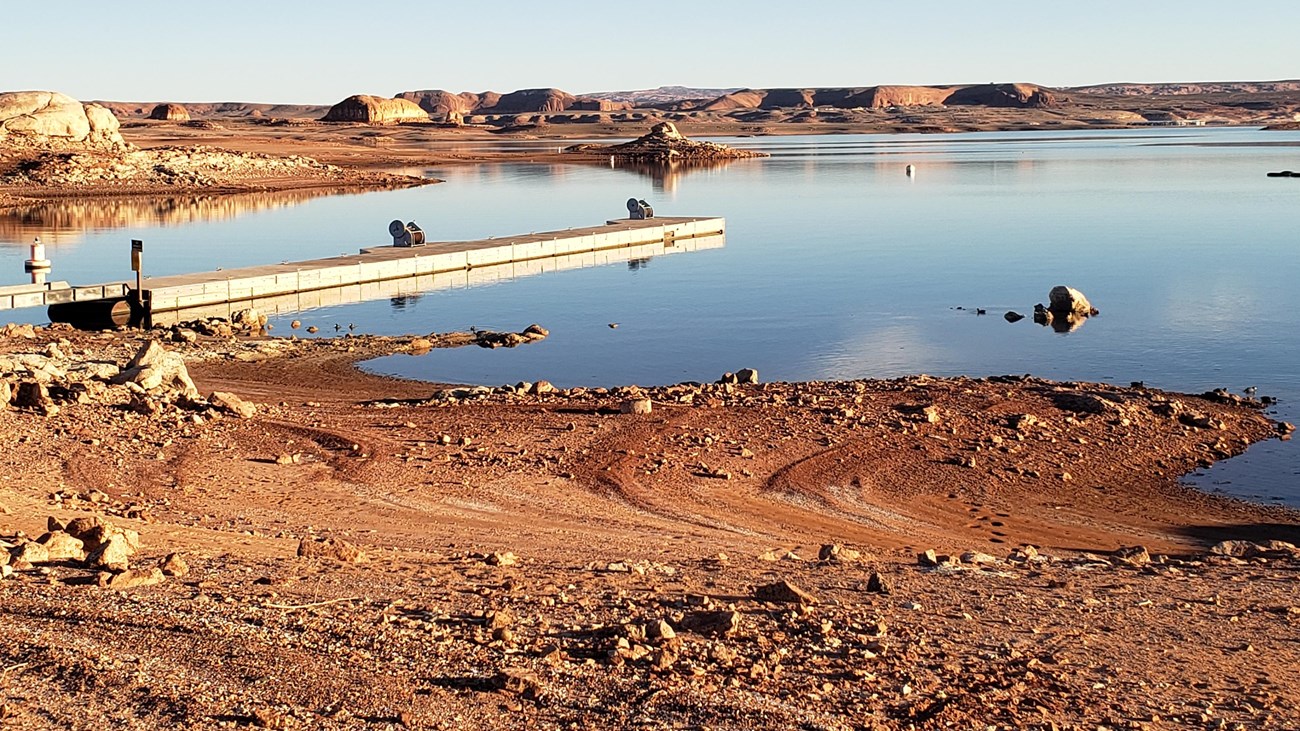
Changing Lake Levels
Lake Powell water levels are changing. How will this affect my visit? |
Last updated: May 1, 2026