



Last updated: June 18, 2026
Place
Desert View Point
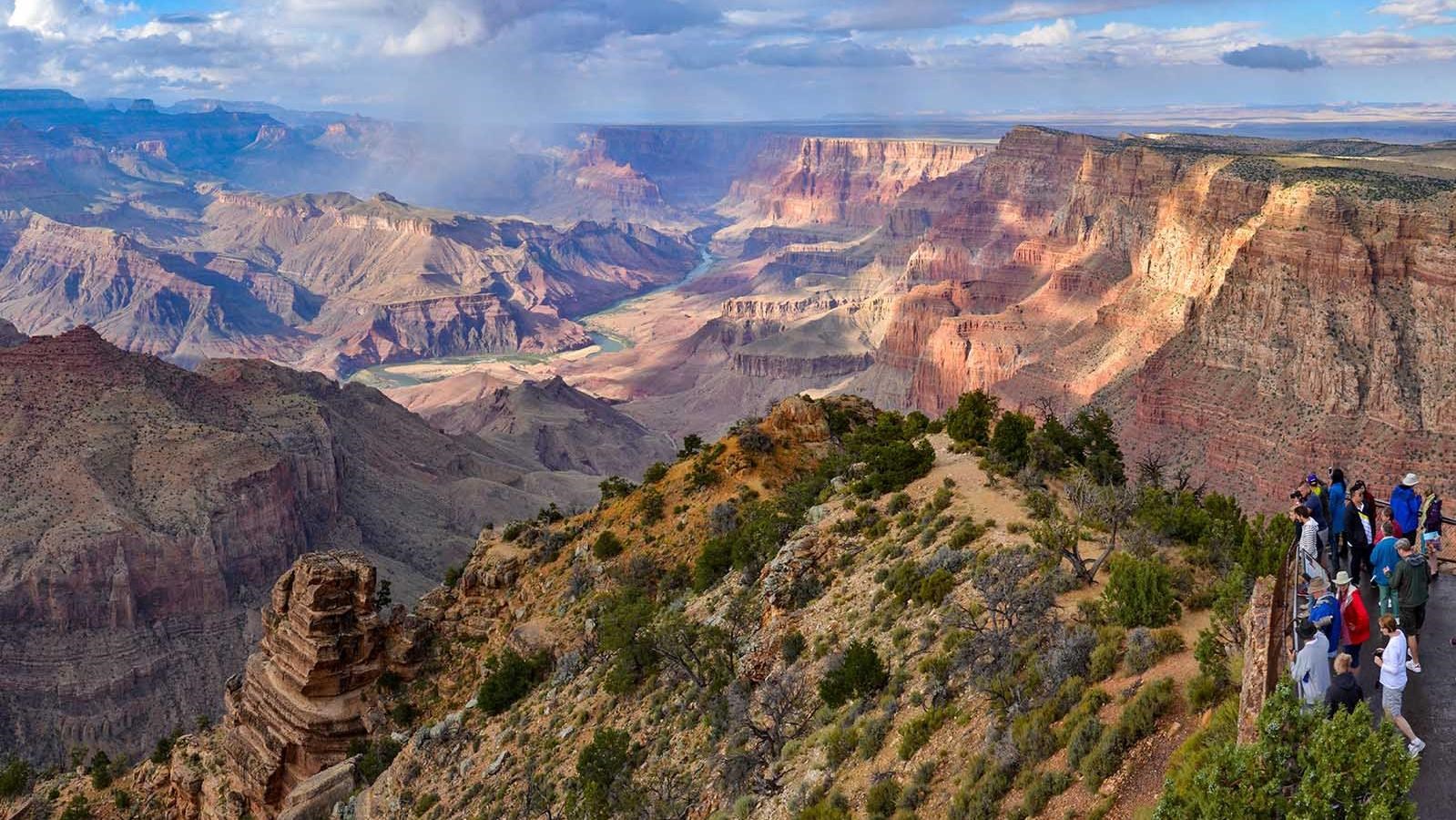
NPS/M.Quinn
Quick Facts
Location:
Desert View
Significance:
Scenic Overlook and Aviation Memorial
Designation:
National Historic Landmark
Amenities
3 listed
Historical/Interpretive Information/Exhibits, Scenic View/Photo Spot, Wheelchair Accessible
Desert View Point (Elevation: 7438 feet/ 2267 meters)
Starting from the main Desert View parking area, a short .25 mile (.4 km) walk takes you past restrooms, the general store/market and the trading post. The point itself is located a few steps beyond the base of the historic Watchtower. There are guardrails around the cliff edge for your safety.
Directly below is the Colorado River's "Big Bend", where it dramatically shifts its previously southward course by executing a sharp 90-degree turn to the west, cutting directly into a major uplift on the Colorado Plateau known as the Kaibab Upwarp. Looking to the west, one can glimpse in the distance where the river plunges into the black, narrow, confined depths of the Granite Gorge.The airline distance to the opposite rim of the canyon is 18 miles; to the Colorado River, 4 miles. The river is about 300 feet wide as seen from Desert View.
To the east, several thousand feet below where you are now standing, is the broad expanse of a plateau known as the Marble Platform, which is part of the Navajo Nation. The brilliant colors of the Painted Desert can be glimpsed in the distance.
Also to the east, and situated back from the Canyon rim, is a prominent flat-topped mesa called Cedar Mountain. Just beyond this mountain the Little Colorado River gorge extends north and south as a crack in the surface of the earth. Tracing the gorge to the left, one may see where it connects with Grand Canyon. The point of connection is where Grand Canyon begins. From that point the Canyon extends 217 miles westward as measured by the Colorado River. Fifty miles of the canyon may be seen from Desert View.
Dark cliffs bordering the Colorado River below Desert View are composed of lavas resulting from volcanic activity long before the cutting of Grand Canyon began. For the most part the walls of Grand Canyon consist of material which hardened into rock after being deposited by wind or water: Consequently, this lava rock is very different in origin and character from the rest of the rocks of the Canyon walls.
Note: the 1956 Air Crash Memorial plaque and wayside have been moved to Navajo Point.