


Last updated: March 19, 2026
Thing to Do
Gettysburg Winter Programs
NPS Photo
Winter Lecture Series 2026
Saturdays and Sundays at 1:30 p.m.
January 10 through March 8, 2026
Gettysburg National Military Park Museum and Visitor Center
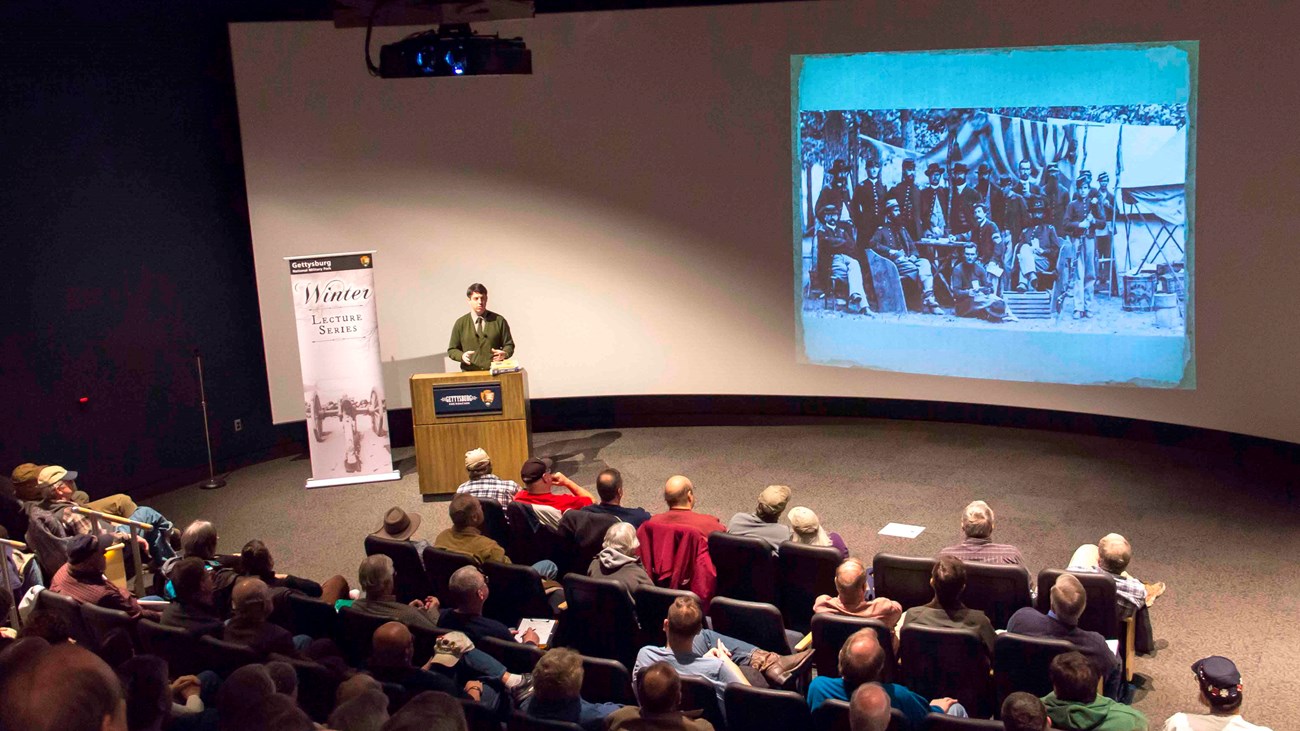
Featuring some of the best Rangers, historians, and authors from across the country, this popular eight-week Winter Lecture Series returns to the Gettysburg National Military Park (NMP) Museum and Visitor Center in 2026!
The Winter Lecture Series is held at 1:30 p.m. on weekends in the Gettysburg NMP Museum and Visitor Center from January 10 through March 14, 2026. Seating is available on a first come – first serve basis. Free tickets are available day of at the Gettysburg NMP Museum and Visitor Center. Schedule is subject to change.
Thanks to the Gettysburg Foundation, all presentations will be recorded and made available on the Gettysburg Foundation YouTube channel at Gettysburg Foundation - YouTube.
No live stream will be available.
Saturday, January 10 - Unfinished Work: Gettysburg Veterans and the Violent Struggle for Reconstruction in Louisiana - Click to watch on the Gettysburg Foundation YouTube Channel
Christina C. Moon, Licensed Battlefield Guide
Despite the surrender of the Confederate armies in 1865, the great task of the Civil War was far from complete. Unfinished Work examines how Gettysburg veterans experienced the fighting shift from the battlefield to southern streets — with many Union veterans working to defend Reconstruction’s promises, while a significant number of former Confederates engaged in campaigns of politics and violence to destroy them. From New Orleans to the rural Red River Valley, the battles over civil rights, federal power, and the nation’s future played out across Louisiana’s fractured Reconstruction landscape.
Sunday, January 11 – Melee at the Brickyard: The 134th New York on July 1, 1863 - Click to watch on the Gettysburg Foundation YouTube Channel
Ranger Andrew Regiec, Gettysburg National Military Park
Explore the courage and sacrifice of the 134th New York Volunteer Infantry Regiment. As Confederate forces overwhelmed United States 11th Corps on the first day of the Battle of Gettysburg, one brigade was moved into the town, to keep thousands of United States soldiers from being cut-off and captured. Of the brigade’s three regiments, the 134th New York went into the battle with nearly 400 men, only about 32 made it to their fallback position that evening.
Saturday, January 17 – Four Score and Five Years Later: America's Reckoning with the Revolution - Click to watch on the Gettysburg Foundation YouTube Channel
Ranger Matt Atkinson, Gettysburg National Military Park
In 1861, the United States reached a defining crossroads, as the unresolved promises and contradictions of 1776 surged to the forefront of national life. Both Union and Confederacy laid claim to the legacy of George Washington and the Founding Fathers, and the outcome of the Civil War would determine whose vision of the Revolution would prevail. In honor of America’s 250th anniversary, this program will explore the echoes, evolutions, and tensions between the ideals of 1776 and the realities of 1861.
Sunday, January 18 – “He Did His Work Bravely And Is At Rest:” The Final Years of General George Gordon Meade - Click to watch on the Gettysburg Foundation YouTube Channel
Ranger John Hoptak, Gettysburg National Military Park
For General George Gordon Meade, service to the country did not end at Appomattox. Instead, it continued until his dying day, which occurred on November 6, 1872, just seven-and-a-half years following the end of the Civil War and less than ten years after his triumph at the Battle of Gettysburg. Join Ranger Hoptak for a look at the oftentimes glossed-over post-Civil War career of George Meade, which, among other things, included his efforts to deter the Fenian Brotherhood from invasions of Canada, his role in Reconstruction, and his July 1869 return visit to Gettysburg to help dedicate the recently constructed Soldiers’ National Monument in the National Cemetery.
Saturday, January 24 – "The Ground Around the Seminary": President Lincoln's Gettysburg Battlefield Excursion - Click to watch on the Gettysburg Foundation YouTube Channel
Historian Codie Eash, Seminary Ridge Museum
Hours before Abraham Lincoln delivered his iconic Gettysburg Address on November 19, 1863, at least three eyewitnesses recalled that the president toured the battlefield, including a personal guard, a foreign ambassador, and United States Secretary of State William Seward. According to the latter, the party “visited the ground around the Seminary, and Mr. Lincoln joined in.” Join Codie Eash, Director of Education and Interpretation at Seminary Ridge Museum and Education Center, as he explores the Lutheran Seminary in the aftermath of battle, examines the role of Seminary personnel in the dedication of Soldiers’ National Cemetery, and uses historical evidence to investigate whether Lincoln made his apparent battlefield visit.
Sunday, January 25 – “Rally ‘Round the Flag”: Color Bearers at Gettysburg
THIS PROGRAM HAS BEEN CANCELED
Ranger Dan Welch, Gettysburg National Military Park
Discover the role color bearers played in nineteenth century armies, the numerous heroic stories of those who carried these powerful symbols in combat at Gettysburg in July 1863, and the legacy of some of these men depicted in bronze and granite of the battlefield today in this compelling program.
Saturday, January 31 - Something Abides: Controversies on the Early Gettysburg Battlefield - Click to watch on the Gettysburg Foundation YouTube Channel
Ranger Erica Uszak, National Park Service Historic Preservation Training Center
Gettysburg was one of the first Civil War battlefields to be established as a national military park—a result of Civil War veterans who feared that they would be forgotten. However, this achievement masked bitter arguments over how to preserve the battlefield, where to place each monument, and who deserved to be recognized. Discover the battle for the memory of Gettysburg, waged by these veterans with literature, litigation, and legislation.
Sunday, February 1 – The Union's Greatest Unsung General: Fighting With and Forgetting Alpheus Williams - Click to watch on the Gettysburg Foundation YouTube Channel
Historian Daniel Brennan, West Virginia University
General Alpheus Starkey Williams was considered one of the Union’s most reliable commanders, having led troops across seven states. Despite this, he began and ended the war with the same rank, passed over for promotion while less experienced men advanced. He once wrote in frustration, “there is an unwritten history…that somebody will be obliged to set right some day.” Discover Williams’s history, marked by battles between personal insecurity and deep pride in his men; between military success and postwar obscurity.
Saturday, February 7– If These Things Could Talk: Objects from the Collection of Gettysburg National Military Park - Click to watch on the Gettysburg Foundation YouTube Channel
Christopher Gwinn, Andrew Regiec, Mike Kwolek, Dan Welch, Matt Atkinson
Every artifact has a voice—if we’re willing to listen. If These Things Could Talk invites you to explore the powerful personal connections that Gettysburg National Military Park staff have with objects in the park’s museum collection. In this special interpretive program, rangers and staff members share the stories behind their favorite artifacts—some well-known, others rarely seen—offering unique insights into the people, events, and legacies of Gettysburg. Join us to uncover how even the smallest item can speak volumes about the past, and reflect on what stories the objects around us might one day tell.
Sunday, February 8 – Outside of Lincoln's White House: Civil War Era Men and Women of the District of Columbia, Maryland, and Virginia - Click to watch on the Gettysburg Foundation YouTube Channel
Ranger Bryan Cheeseboro, Civil War Defenses of Washington, D.C.
Most histories of Washington, D.C. during the Civil War only talk about President Lincoln, Congress, and the familiar national landmarks of the city. Most people know very little about the District of Columbia (which in 1861 was the same size as Gulfport, Mississippi today) and the ordinary people who called Washington City and the surrounding Maryland and Virginia countryside home during the War of the Rebellion. Using photographs, original writings and other researched information, Ranger Cheeseboro brings to light the stories of “everybody else” and presents a diversity of Union and Confederate men and women, Blacks and Whites, and free and enslaved in and around Washington during the war.
Saturday, February 14 – Captured at Gettysburg! The Prisoner of War Experience at the High Water Mark of the Civil War - Click to watch on the Gettysburg Foundation YouTube Channel
Ranger Christopher Gwinn, Chief of Interpretation and Education, Gettysburg National Military Park
What was the experience of those taken captive during the Battle of Gettysburg? This program explores the harrowing experiences of Union and Confederate prisoners of war—from the moment of capture to their uncertain fates beyond the battlefield. Join us as we examine how the Gettysburg National Military Park memorial landscape remembers, reveals, and sometimes overlooks this important chapter in the Gettysburg story.
Sunday, February 15 – "My heart yearns to have his remains": Dr. J.W.C. O'Neal and the Repatriation of the Confederate Dead at Gettysburg - Click to watch on the Gettysburg Foundation YouTube Channel
Ranger Dan Welch, Gettysburg National Military Park
Although much is known about the creation of the National Cemetery and the reburial of the Union dead thereof, little has been written or remembered about the Confederate remains left behind on the battlefield. One of several important figures to this story, Dr. John W.C. O'Neal, worked diligently to record the locations of these dead and their identities. He further worked with families across vast distances and periods of time to locate their loved ones remains and have them shipped back to their hometown and family cemeteries. Learn more about Dr. O'Neal, his work with the Confederate dead, and the stories of closure he brought many southern families.
Saturday, February 21 - A National Shrine: The History of Gettysburg National Cemetery - Click to watch on the Gettysburg Foundation YouTube Channel
Ranger Daniel Vermilya, Eisenhower National Historic Site
Well known as the location of Lincoln's famed Gettysburg Address, Gettysburg National Cemetery has a deep and powerful history beyond November 19, 1863. This cemetery's evolution from a small-town hill to a battleground, to a necessary burial ground, to iconic hallowed ground, encapsulates how Americans have fought, sacrificed, and cared for their fallen for generations. As part of the America 250th commemorations, join Eisenhower NHS Ranger Dan Vermilya to explore the history and meaning of Gettysburg National Cemetery and those who are buried there.
Sunday, February 22 – The Boy Major: Joseph W. Latimer in the American Civil War
THIS PROGRAM HAS BEEN CANCELED
Historian Billy Griffith, Gettysburg Foundation
Brentsville, Virginia native Joseph White Latimer was one of the rising stars in the Confederate Artillery when his life was tragically cut short at age 19 following a mortal wound received at the Battle of Gettysburg on July 2, 1863. When the Civil War commenced, Latimer was in his second year at the Virginia Military Institute. He did not return to complete his studies, however, and instead joined the Courtney Artillery in September 1861 as a second lieutenant. His star rose quickly despite his young age, and he was made a major in R. Snowden Andrews’ Battalion by the spring of 1863. Affectionately referred to as the “Boy Major,” Latimer’s decision to join the fight, which he made while home in Brentsville in August 1861, placed him on the path to Gettysburg and towards an untimely death.
Saturday, February 28 – Finding R.H. Weakley - Click to watch on the Gettysburg Foundation YouTube Channel
Ranger Susan Ashman, Springfield Armory National Historic Site
During and after the Civil War, thousands of firearms were sent back to Springfield Armory. Some of these with soldier’s names, battles fought, artwork, and sweethearts – all carved in the stock. Similar to books on a library shelf, historic firearms have a story to tell. Most remain silent, but some are waiting for their story to be told, anonymous no longer. From a family farm in Tennessee to the Battle of Franklin, Finding R.H. Weakley is one of those stories. Sadly, not all have a happy ending.
Sunday, March 1 – Longstreet's Attack on July 2 - Click to watch on the Gettysburg Foundation YouTube Channel
Ranger Matt Atkinson, Gettysburg National Military Park
Join Ranger Matt Atkinson as he peels back the layers of myth to explore the actions of Lt. Gen. James Longstreet and his men in the attacks on July 2, 1863.
Saturday, March 7 – One War at a Time: Diplomacy during the Civil War
Ranger John Nicholas, Gettysburg National Military Park
While battles raged across American soil, another struggle unfolded in quiet rooms and diplomatic courts across the ocean. Join Ranger John Nicholas to explore how Union leaders worked to prevent foreign recognition of the Confederacy, and how President Lincoln’s shrewd diplomatic strategy—summed up in his phrase “One war at a time”—helped preserve the Union by keeping Europe out of America’s Civil War. Discover the high-stakes world of Civil War diplomacy and the international threads woven into the Gettysburg story.
Sunday, March 8 - In Camp & Field 1861-1865: The Civil War Through the Lenses of the Stereopticon - Click to watch on the Gettysburg Foundation YouTube Channel
Tyrone & Sue Cornbower
Visitors can step back in time for a historical audio-visual experience reminiscent of magic lantern shows of the past. Guests can view images from original magic lantern slides projected through the lenses of an 1890s stereopticon, accompanied with narration and music played on an 1880s portable parlor organ. Cornbower is the operator and narrator, along with Sue Cornbower providing music on the organ.
Rescheduled
Saturday, March 14 - A Fragment Spared by Time – 1938 Reunion - Click to watch on the Gettysburg Foundation YouTube Channel
Richard Goedkoop, Licensed Battlefield Guide
The 75th anniversary of the Battle of Gettysburg marked the largest gathering in the town’s history. This illustrated program explores the origins and major events of the reunion, culminating in the dedication of the Eternal Light Peace Memorial. Highlights include President Franklin D. Roosevelt’s commemorative address, as well as a reflection on the reunion’s impact and enduring memory.
Rescheduled
Sunday, March 15 – The Boy Major: Joseph W. Latimer in the American Civil War
Historian Billy Griffith, Gettysburg Foundation
Brentsville, Virginia native Joseph White Latimer was one of the rising stars in the Confederate Artillery when his life was tragically cut short at age 19 following a mortal wound received at the Battle of Gettysburg on July 2, 1863. When the Civil War commenced, Latimer was in his second year at the Virginia Military Institute. He did not return to complete his studies, however, and instead joined the Courtney Artillery in September 1861 as a second lieutenant. His star rose quickly despite his young age, and he was made a major in R. Snowden Andrews’ Battalion by the spring of 1863. Affectionately referred to as the “Boy Major,” Latimer’s decision to join the fight, which he made while home in Brentsville in August 1861, placed him on the path to Gettysburg and towards an untimely death.
Details
Duration
45-60 Minutes
Activity
Guided Tours
Pets Allowed
No
Activity Fee
No
Entrance fees may apply, see Fees & Passes information.
Location
Gettysburg National Military Park Museum and Visitor Center
Reservations
No
Season
Winter
Time of Day
Day
Accessibility Information
Indoor winter programs are physically accessible.